
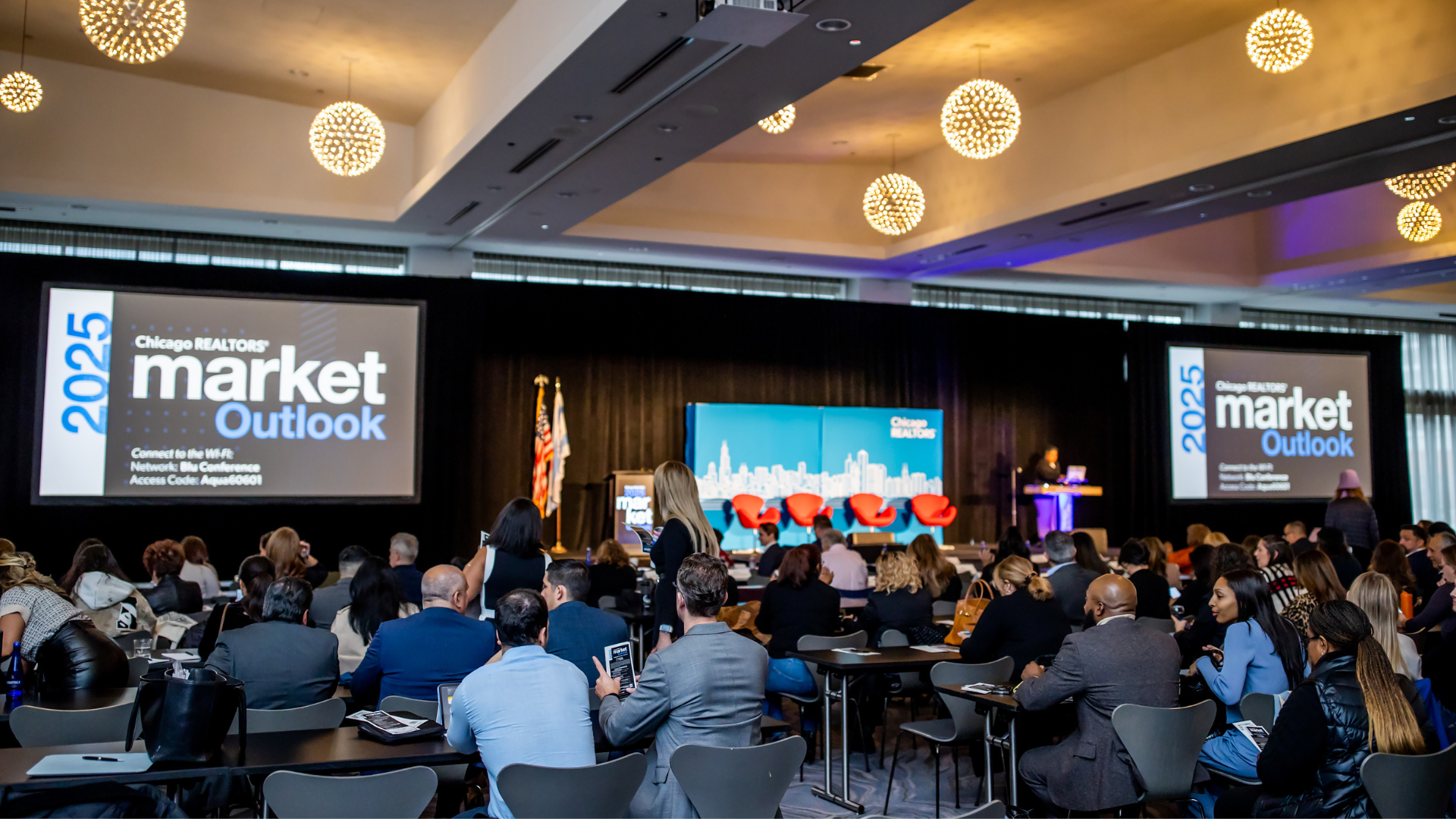


At the 2026 Market Outlook, Adrian Brizuela, Associate Director of Market Analytics for CoStar, delivered a comprehensive look at where Chicago’s commercial real estate market stands today and what REALTORS® should expect as we move through 2026.
Drawing on CoStar’s national and local data, the session walked through key trends shaping multifamily, industrial and retail real estate, providing critical context for advising clients, evaluating opportunities and understanding how Chicago compares to markets across the country. Review Adrian’s slideshow and key session takeaways below.
Multifamily: Tight Market Conditions Continue
Multifamily continues to be one of Chicago’s strongest commercial sectors. Roughly half of all apartment demand across the metro area occurs within the city, underscoring Chicago’s outsized role in driving rental activity regionally.
While demand is expected to slow modestly in 2026 following population gains tied largely to international immigration, supply constraints remain a defining factor. New deliveries are projected to be limited and concentrated earlier in the year, with more meaningful construction activity not expected until 2027 and 2028.
This imbalance keeps vacancy well below national norms and reinforces Chicago’s position as one of the tightest rental markets in the country.
“Chicago’s multifamily market continues to benefit from steady demand and a supply pipeline that remains constrained.”
Rent Growth: Still Above the National Average
Chicago has ranked among the top five U.S. markets for rent growth for seven consecutive quarters, a reflection of its undersupplied rental market.
Notable rent growth trends:
- Citywide rent growth is currently above 4% year-over-year.
- Highly amenitized, newer properties are outperforming older inventory
- Rent growth is expected to moderate toward the 2% range in 2026 but remain above the national average.
This moderation reflects normalization following several years of strong gains.
Investment Activity: Capital Is Flowing — Selectively
Multifamily investment activity rebounded in 2025, with transaction volume increasing year-over-year and outpacing national trends. Downtown Chicago and the North Lakefront once again led the market, accounting for the largest share of dollar volume and the highest prices per unit.
Beyond the urban core, select suburban submarkets also saw strong investor interest — particularly areas with access to employment centers, transit and long-term demographic stability. Overall, pricing trends and deal flow point to continued confidence, even amid a more cautious national investment climate.
Industrial: Adjusting, but Still Competitive
Chicago’s industrial sector is recalibrating after the surge seen during the pandemic. Slower port activity and uncertainty around trade policy have tempered leasing velocity, leading to rising — but still healthy — vacancy levels.
Vacancy now sits below the national average, and Brizuela emphasized that Chicago’s role as a major inland distribution hub remains intact. The outlook for 2026 is largely one of stabilization, with recovery expected to take hold as existing space is absorbed and policy conditions become clearer.
Key industrial signals to note:
- Specialized industrial space is proving more resilient than logistics and distribution
- Vacancy remains well below national levels despite recent increases
- Data centers are emerging as a meaningful growth area, with new projects planned across the city and metro area
Retail: Stability Through Limited Supply
Chicago’s retail market continues to adjust following a wave of national store closures in late 2024. However, limited new construction has helped prevent significant spikes in vacancy, allowing the market to absorb space more gradually.
Neighborhood-serving retail formats remain the strongest performers, particularly strip centers anchored by service-based tenants that cannot be replicated online. Smaller-format spaces — especially those under 10,000 square feet — are seeing the most consistent demand.
Looking ahead, large-scale downtown investments could help reenergize retail activity in the Loop. Projects such as Google’s Thompson Center redevelopment and the LaSalle Street Reimagined initiative are expected to bring new employees and residents into the central business district, supporting foot traffic and long-term retail viability.
Why This Matters for Chicago REALTORS®
Across all sectors, the outlook points to normalization, not decline. Chicago continues to outperform many national peers due to constrained supply, strategic location and diverse demand drivers.