


When artist Marisa Morán Jahn and architect Rafi Segal began designing an installation for the National Public Housing Museum, they did not keep the work confined to a studio.
They brought an early prototype into a local community center, invited residents to try it and listened to what they had to say. That process helped shape the final installation, which now lives outside the museum on Chicago’s Near West Side.
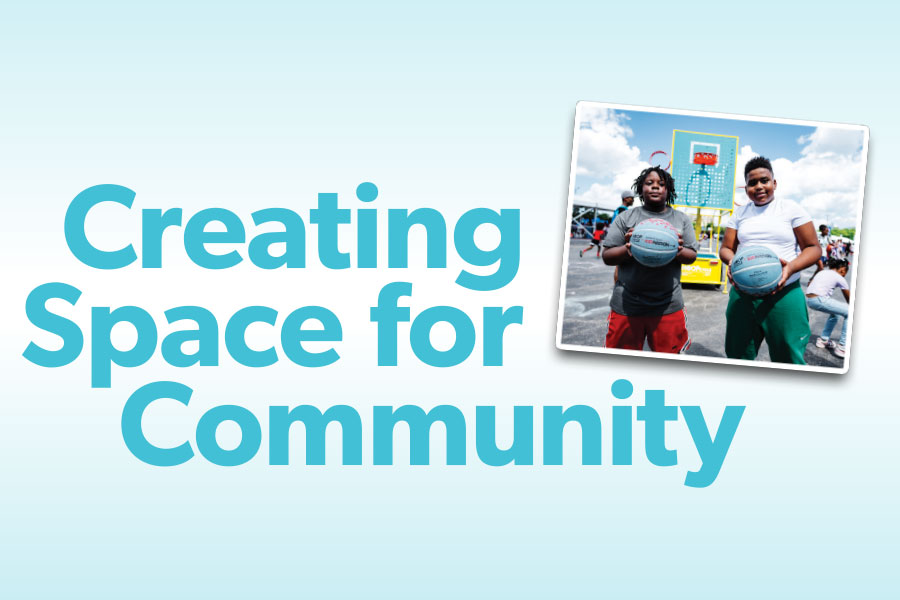
The result is HOOPcycle, a tricycle-mounted basketball structure that blends the energy of pickup games with the sport’s pre-Columbian roots. Nearby, OOPS, an interactive ground mural in the museum’s parking lot, draws from street courts and sidewalk games to invite visitors into the space.
Together, the pieces create an outdoor gathering place centered on play, movement and connection.
A Museum Built From the Inside Out
The National Public Housing Museum is unlike any other museum in the country; it is the first cultural institution dedicated to interpreting the American experience in public housing. It’s located inside a former public housing building at 919 S. Ada St.
on Chicago’s Near West Side.
Its mission is straightforward and ambitious: to preserve, promote and propel the right of all people to a place where they can live and prosper.
HOOPcycle and OOPS were not simply commissioned by the museum. They are now part of the fabric of a place that invites visitors to reconsider what public housing communities are, what they have been and the stories they hold.
For Chicago REALTORS®, that location matters. This is not art installed somewhere abstract. It is on the ground, in the city and in a neighborhood whose history is deeply connected to community and belonging.
More Than the Property
The Chicago Association of REALTORS® Foundation supported this project because it reflects a core belief behind the Foundation’s work: strong communities are shaped not only by housing, but by the places, relationships and shared experiences that surround it.
For Chicago REALTORS®, that connection is familiar. A neighborhood is more than a collection of properties. It is the block where kids play after school, the sidewalk where neighbors stop to talk and the gathering spaces that help people feel rooted.
Those things may not always show up in a listing, but they shape how people experience where they live. They influence stability and the sense of connection that helps neighborhoods grow stronger over time.
Projects like HOOPcycle and OOPS help make those connections visible. They bring creativity and investment into a place tied to Chicago’s public housing history, while inviting residents and visitors to experience the museum as an active community space.
Built With the Community
Residents were not an afterthought in this process. Community members had the opportunity to interact with an early HOOPcycle prototype at a local community center and offer feedback that informed the final design.
That input can be seen in the way the installation encourages movement and play. It is not something visitors simply look at. It is something they can step into.
Basketball courts, sidewalks and outdoor gathering spaces have long been places where relationships form and local traditions are passed down. HOOPcycle and OOPS honor that history by framing everyday community life as something worthy of attention.
The Spaces Around Home
When residents and visitors encounter HOOPcycle and OOPS, they are invited to see a parking lot as more than leftover space. They are invited to play, gather and participate in a broader story about public housing, creativity and community pride.
For the Foundation, supporting the National Public Housing Museum is part of a broader commitment to Chicago’s neighborhoods and to the people who give those neighborhoods their life.
HOOPcycle and OOPS may begin with a court, a tricycle and a mural, but the larger story is about listening and honoring the everyday places where community takes shape.
For Chicago REALTORS®, that is a familiar reminder: housing matters deeply, but so do the spaces that help people feel connected to home.
The partnership between the Foundation and the National Public Housing Museum shows what’s possible when organizations come together for a shared purpose. It’s a reminder that community development isn’t only about units built or deals closed. Sometimes it’s about a mural on the ground and a hoop on a tricycle, designed by an artist and an architect who took the time to listen first.
For Chicago REALTORS®, that’s a lesson worth taking to heart.
About the Chicago Association of REALTORS®
Our mission is to make Chicago’s communities stronger, more vibrant and more accessible by leveraging the collective power of REALTORS®, partners and mission-driven investments.
The Chicago Association of REALTORS® Foundation contributes to the future of real estate and our diverse communities through education, charitable giving and outreach.
Whether you’re interested in applying for a scholarship, supporting our charitable efforts or wanting to stay informed about the Chicago Association of REALTORS® Foundation’s activities, visit us!