
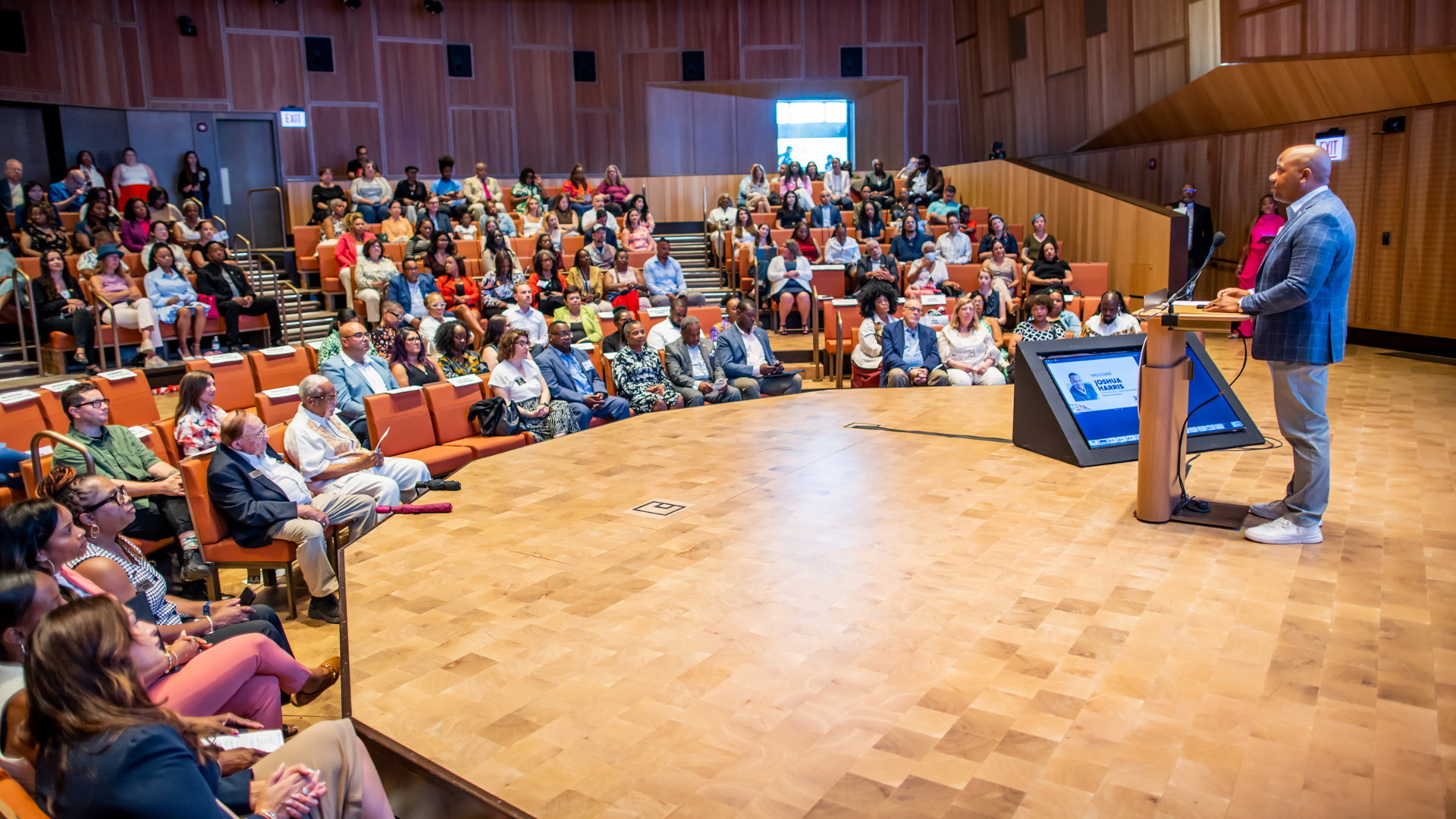




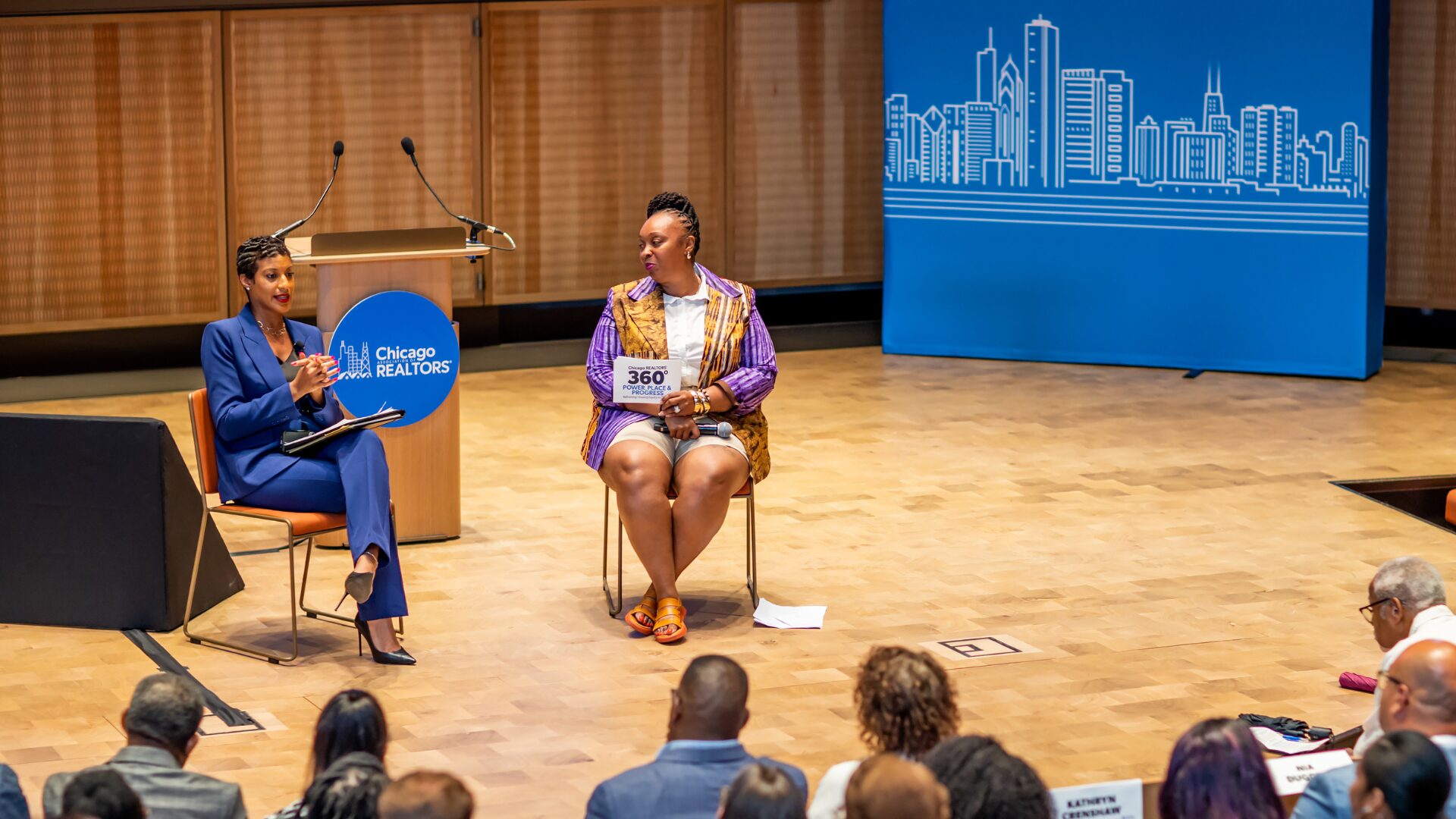
On Thursday, August 5th, Chicago REALTORS® 360°: Power, Place & Progress brought REALTORS® together at the Obama Presidential Center for a morning on reframing housing equity in Chicago. Following a look back at how the city’s housing history shaped today’s disparities, Commissioner Ciere Boatright of the Chicago Department of Planning and Development (DPD) took the stage to look forward, with an update on the development happening right now across all 77 community areas.
Keep reading for the numbers behind the city’s building boom and her take on what it will take to make that growth equitable.
Listen to the Session in Full
Missing Middle: A Market-Rate Strategy for the South and West Sides
Boatright opened with data that framed everything that followed: Chicago’s South and West Side communities have lost half of their 1960s population, and the city overall has lost population equivalent to Boston’s current population over the last 30 to 40 years.
DPD’s response is Missing Middle, the city’s market-rate housing strategy. The initiative started in late 2024 in North Lawndale and has since expanded to South Chicago, Chatham and Morgan Park. It uses city-owned land alongside the mayor’s housing and economic development bond to offer developers subsidies of up to $150,000 per unit, closing the appraisal gap that has made new construction difficult to finance in disinvested neighborhoods. Missing Middle is for two-to-six-unit buildings, and it’s slated to bring nearly 700 new units online in the next couple of years, with construction already underway.
Quick Tip: Boatright specifically shouted out REALTORS® who’ve attended DPD’s Missing Middle and RFP webinars. If you haven’t yet, that’s a direct way to know about new development opportunities before they’re public.
From Empty Towers to Homes: The LaSalle Street Conversions
Downtown, the LaSalle Street Revitalization Initiative is converting vacant office towers into housing. The $900 million investment, backed by $320 million in tax increment financing, is removing 60 stories of vacant office space from six high-rise buildings and replacing it with 1,700 mixed-income apartments, with 30% of units set aside as affordable. “That’s a big deal,” Boatright said. “Not 20%. 30%.” Twenty-nine additional TIF-assisted conversions are advancing behind those first six, and DPD just broke ground on more than 300 units at 500 N. Michigan Ave.
Citywide, Boatright pointed to 26 office-to-residential conversions worth $1.8 billion in investment and 4,000 units that, as she put it, “you will never see a crane on.”
Inside a $20 Billion Pipeline of Mega Developments
Chicago’s largest development sites are moving forward at what Boatright called “lightning speed” under the current administration. A few highlights from her rundown:
- The 78, anchored by Chicago Fire FC’s new 22,000-seat, $850 million stadium, is entering the second phase of an $8 billion development that includes 10,000 new housing units, backed by $400 million in infrastructure investment approved by City Council last month.
- Foundry Park, formerly known as Lincoln Yards, is a $3 billion project bringing 3,700 mixed-income housing units and 970,000 square feet of office, retail and hotel space, with groundbreaking expected this fall.
- The 1901, on the Near West Side surrounding the United Center, is a $7 billion, multi-phase development that broke ground in June and will eventually include a music venue, a hotel, retail and nearly 10,000 new housing units.
- The Illinois Quantum Microelectronic Park, an $8 billion project on the former U.S. Steel site on the far South Side, sits on nearly 400 acres, larger than Lincoln Yards, The 78 and Bronzeville Lakefront combined. Advocate Health broke ground there in June as the first new hospital on the South Side in more than 100 years.
Altogether, Boatright counted more than $20 billion in construction currently underway across these sites, on top of nearly $11 billion in Plan Commission approvals in 2024 and $10.1 billion in 2025, supporting more than 12,000 new housing units.
Cutting the Tape: Faster Approvals, More Building
Boatright was direct about what slows development down: “Time kills deals.”
Under the mayor’s Cut the Tape executive order, DPD has reduced average Plan Commission application timelines from 135 days to 79 days, cut land evaluation timelines from six months to one month and reduced right-of-entry timelines from months to days. Design reviews have gone from three meetings to one, and the city has reduced its inventory of vacant lots from 10,000 to 7,000, with 70% of that remaining inventory designated for vertical development. Since May 2023, DPD has advanced more than $1.6 billion in financial incentives, supporting over $13 billion in new investment citywide.
Reframing Housing Equity: “It’s Not Gentrification Unless There’s Displacement”
The second half of Boatright’s session was a fireside chat built around the event’s central theme. When asked what “reframing housing equity” means to her, she pointed first to mindset: “We have to think about housing as a human right,” she said, adding that the term often gets narrowed to deeply affordable housing alone, when the real need spans every income level, from 30% AMI (area median income) up through the missing middle.
She also pushed back on how loosely the term gentrification gets used. “The G word is a real word, and it affects many neighborhoods,” she said, “but it’s not gentrification unless there’s displacement.”
Her broader point: Chicago needs more density and more rooftops in disinvested neighborhoods to support the retail those neighborhoods deserve, without pushing out the residents who are already there.
That requires what she called authentic community engagement, meaning planning with a neighborhood, not for it. In practice, she pointed to protections like grant opportunities, inclusive zoning and giving longtime residents a path to acquire and build on the vacant lot next door, turning proximity into generational wealth rather than displacement. And she was candid about her own place in that process: “I can’t make decisions on the 10th floor in my office at City Hall for 2.75 million people. It’s not fair. It’s not appropriate. Who am I to tell you what’s best for your neighborhood?“
She also connected the dots back to the day’s larger theme. “We’ve got a narrative problem here in Chicago,” Boatright said. Big investments are reshaping the skyline, she said, “but we’ve got to talk about it,” so residents across the city, not just downtown, know what’s coming to their own community areas.
How REALTORS® Can Partner With the City
Boatright closed with a direct ask for the room. DPD publishes every Plan Commission approval dating back to 2023, searchable by community area, ward and developer, including unit counts, so REALTORS® can reach out to developers directly and know what’s coming online before their clients do.
Action Step: If you haven’t already, bookmark DPD’s Plan Commission tracker. Reaching out to a developer directly about timing is fair game, and Boatright said her office welcomes it.
Action Step: Speak up. Boatright specifically encouraged REALTORS® to flag ordinances that don’t sit right, framing it as a two-way partnership rather than a one-sided ask.
About what success would look like five years from now, Boatright pointed to these indicators:
- The city’s vacant lot inventory dropping close to zero
- Revitalized storefronts across neighborhoods, with a vacant storefront activation program already underway in 13 of them
- A more diverse pool of developers, not just the usual mega-project players, growing into capacity to take on larger sites
- Getting Chicago’s population back toward 3 million for the first time since 1980.