
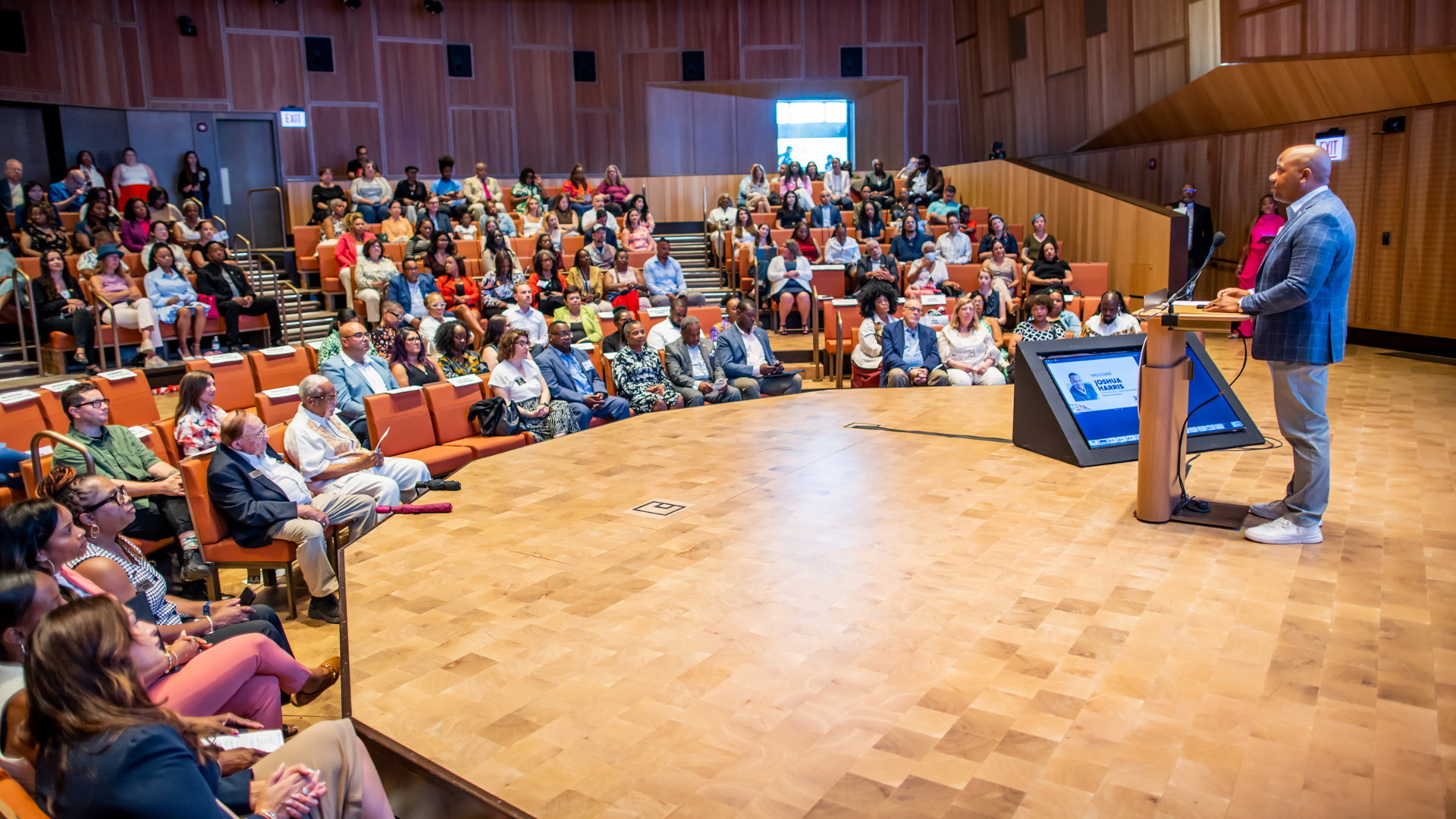


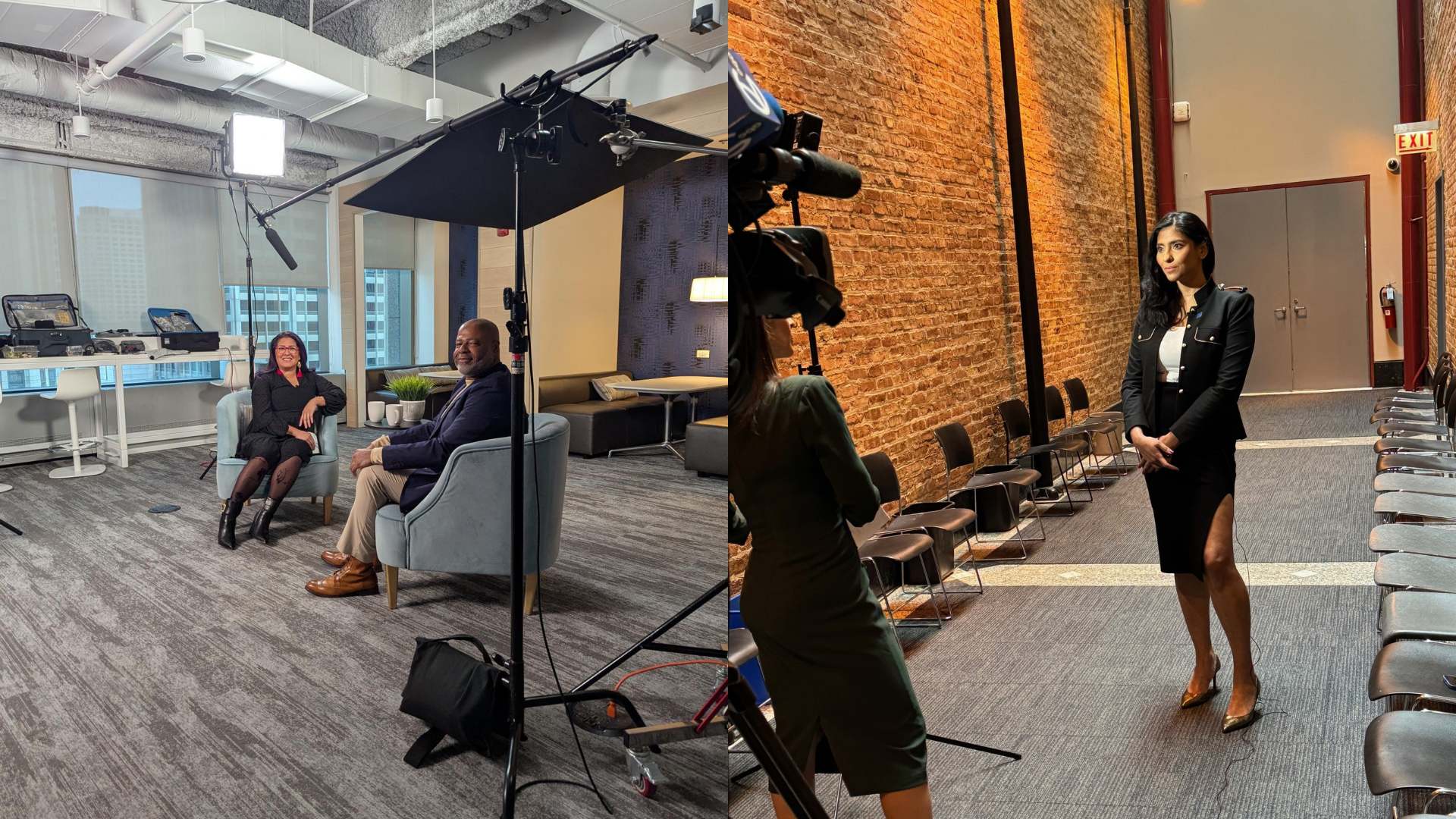

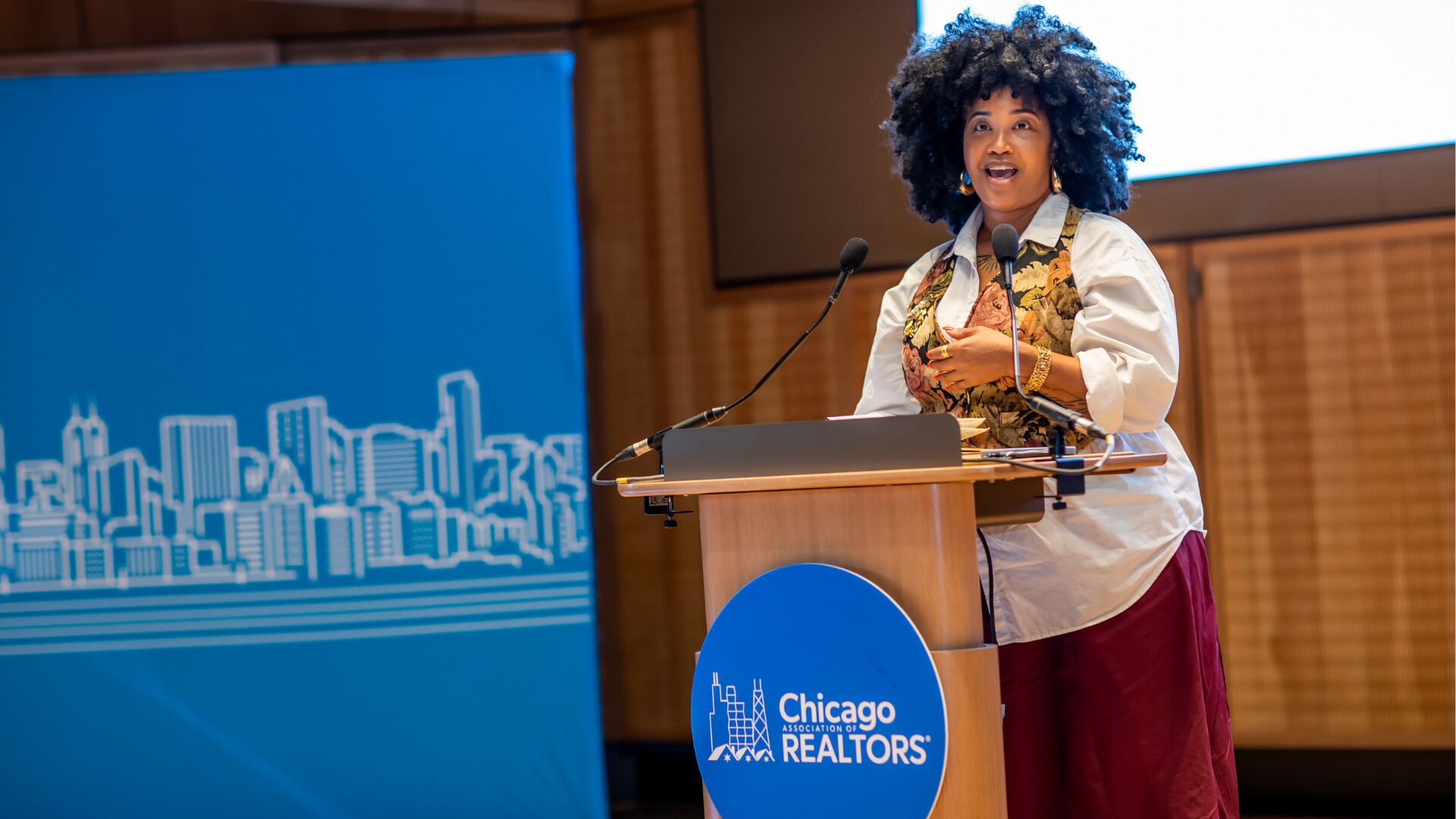
Chicago REALTORS® 360°: Power, Place & Progress closed on Thursday, August 5th, with a speaker who’s spent her career turning Chicago’s housing data into something harder to look away from: art.
Tonika Johnson, a nationally recognized Chicago-based artist, researcher and storyteller, is the Founder of the Folded Map Project and a MacArthur Fellow. Her work uses portraits, maps and public installations to make segregation and disinvestment visible in ways spreadsheets can’t.
Keep reading for the stories she shared at the Obama Presidential Center and what she says REALTORS® can do with them.
Listen to the Session in Full
The Folded Map Project: What Two Addresses on the Same Street Can Teach Us
Johnson’s best-known work, the Folded Map Project, pairs residents who live at corresponding addresses on Chicago’s North and South Sides, people she calls “map twins,” and brings them together to talk about how differently their identical addresses have played out. A short video she shared for the room contrasted the same stretch of Ashland Avenue on the North Side and the South Side: street lighting, grocery stores and restaurants plentiful on one end, largely absent on the other. “None of which have anything to do with gun violence,” the video noted. “Only disinvestment.”
In one televised segment revisited during her talk, two map twins compared what they’d each paid for their homes: $61,000 versus $535,000. “I think the awkwardness helps people understand how we’re all participating in this system that was created before us,” Johnson said. One pair of map twins later co-founded Englewood Renaissance, a group now focused on beautifying parts of Englewood and increasing homeownership there.
“This isn’t just dots on a map,” Johnson told the room. “This is talking about all of us today.” She used that line to pivot to her own neighborhood, Greater Englewood, where the homeownership rate has hovered around 30% for decades. Her curiosity about why that number never moved led her to the rest of her work.
The Women of Winchester: A Simple Question That Reveals Decades of History
Johnson shared a second pairing she jokingly calls “the Women of Winchester,” two residents who live on the same Chicago street and became fast friends. In a recorded conversation, one shared that the multi-unit building that’s been in her family for generations cost roughly $30,000 when it was purchased in 1974. The other had bought her home in Rogers Park about seven years earlier, in a market where prices had already climbed well past that figure.
“It’s not ancient history,” Johnson said of the gap those numbers represent. “It’s the legacy of these practices from the mid-century that are with us today, and they will continue to be with us, because the value of these homes is the value of these homes.” As long as that underlying economic disparity exists, she said, the difference in outcomes will persist.
Inequity for Sale: How Land Sale Contracts Stole Black Wealth in Englewood
Johnson’s newer project, Inequity for Sale, focuses on a more specific mechanism: land sale contracts. In the 1950s and ’60s, these predatory financing arrangements sold homes to Black families at steep markups, without a mortgage and without informing buyers that they didn’t actually hold the deed. Buyers took on all the responsibilities of homeownership with only the legal standing of a renter, and could be evicted for missing a single payment. The practice stole more than 3,300 homes, and counting, from Black Chicagoans, a toll later quantified in the research report “The Plunder of Black Wealth in Chicago: New Findings on the Lasting Toll of Predatory Housing Contracts.”
“A lot of the homes that are in Englewood now that are abandoned, a lot of the vacant lots, were land sale contract properties,” Johnson said. “We are living amongst evidence of this crime, and we didn’t know it.” In partnership with the National Museum of Public Housing, her project places landmarkers in front of identified land-sale-contract homes to memorialize the families who lived there.
Johnson also played a clip of historian Beryl Satter, author of “Family Properties,” a book about the same practice as it played out in Chicago’s Lawndale and Englewood neighborhoods. Satter’s research found that many of the families who first moved into these neighborhoods were striving, middle-class Black homebuyers paying top dollar for a better life, not the poor families later blamed for the neighborhoods’ decline. Wealth was systematically extracted from those communities, Satter’s research shows, through the land sale contract process itself.
“Don’t Go”: Naming the Narrative That’s Held Neighborhoods Back
Johnson closed with the throughline connecting all of her work: the stories Chicagoans are told, and repeat, about the South and West Sides. She asked the room to raise their hands if they’d ever been told the South Side was dangerous and to stay away. Nearly every hand went up. “That is present-day redlining,” she said. “That is how this history is with us today. That is the exact narrative that we have to change.”
That question is also the premise of her book, “Don’t Go,” co-written with sociologist Maria Krysan, a collection of first-person stories from Chicagoans who were warned away from certain neighborhoods and what happened when they went anyway. Several volunteers from the audience read short excerpts live. Johnson’s advice for REALTORS® who hear a version of that narrative from a client or colleague was direct: “When people talk negatively about an entire side of the city, it’s your duty to correct them or educate yourself.”
What REALTORS® Can Do: Go Run the Errands
During the Q&A, a REALTOR® asked how to respond when out-of-state clients ask them to serve as the judge of whether a neighborhood is “safe.” Johnson’s answer: point them toward the history first. “It’s important for them to understand how a neighborhood became what it is,” she said, “because once you know that, you can assess for yourself.”
To make that concrete, Johnson described the Folded Map Action Kit, a self-guided list of everyday errands, like buying groceries or visiting the library, done in a neighborhood that’s economically and racially different from your own. The goal isn’t a drive-through impression. It’s showing up as a resident would.
Action Step: Next time you’re advising a client on an unfamiliar neighborhood, resist leading with your own read on it. Point them to the neighborhood’s actual history and data, run an errand there yourself if you haven’t and let them draw their own conclusions.